Tuesday, January 28, 2025

सुमन कल्याणपूर यांना ८८व्या वाढदिवसाच्या हार्दिक शुभेच्छा!

भारतीय संगीतक्षेत्रातील सुवर्णअध्याय लिहिणाऱ्या महान गायिका सुमन कल्याणपूर यांचा ८८वा वाढदिवस! 

२८ जानेवारी १९३७ रोजी ढाका येथे जन्मलेल्या सुमनताईंच्या सुरेल आवाजाने हिंदी, मराठी, बंगाली आणि इतर भाषांमध्ये रसिकांच्या मनावर अधिराज्य गाजवलं. त्यांची गायकी, साधेपणा आणि सुरेलतेची जादू आजही अविस्मरणीय आहे.


Article by Lata Ballal 

दिलने फिर याद किया !🎼🌟🎻🌙🌈

ऐकलं आणि सुमन कल्याणपूर  चा प्रसन्न  चेहरा डोळ्यासमोर  तरळला आणि अनेकानेक गीतांची गर्दी झाली . किती गोड कंठ !! कदाचित  मातीचा गुण असेल! "रोशगुल्ला" च्या प्रांतातील जन्म ना!!!😀🙏🏻पण खरंच कसं बरं वर्णन करावं? माजघरातील कांकणाची  किणकिण? की शालीन ,घरंदाज युवतीने थोरामोठ्यांचा आब राखित ,अधीर भावनांना धिराने सावरत गुणगुणलेलं सूर! काही म्हणा पण आपल्याच घरातला ,ओळखीचा वाटणारा मधाळ स्वर ,म्हणजेच सुमन कल्याणपूर!सोनटक्यापरी मंद शुभ्र !! हे " शुभ्र कांही जीवघेणे" असले तरी अदा मात्र कातील नाही !! तिची (अरे देवा म्हणतो ना, तद्वत)!

गणाधीपाss..,तुझ्या कांती सम ...भक्ती गीतं ऐकली की ,धूपगंध दरवळत  राहतो मनांत!!आणि समईच्या शुभ्र कळ्यात उजळतो !!🪔🌟

तर केतकीच्या बनांत  अलगद नेऊन सोडते , आणि मनमोर नाचू लागतो !  हेच तर वैशिष्ट्य !! मराठी ,बंगाली , गुजराती ,आणि हिंदी  किती एक गाणी तिने खुबीने गायली!! कुठलाही आविर्भाव न आणता, अगदी सहज साधं सुंदर! पण त्या त्या माहोलमध्ये कासेनांना डुंबवत!! ते ही अगदी कळू न देता.सगळीच गाणी अवीट गोडीची आणि नजाकतीनं भारलेली!

म्हणूनच आजकल "तेरे मेरे  प्यार के चर्चे" थिल्लर झालं नाही! बिनधास्त ,खुलेपणाने ऐकावी अशी एकाहून एक सुरस गीतं !!पण मला मात्र ,"बात एक रातकी "मधलं "ना हम तुम्हे  जाssने,...हे काळजात कोरून ठेवावंस वाटतं !!!  गाणं कधी संपलं कळतच नाही , मन मात्र त्या सुरातंच लपेटून राहतं ! गारुड आहे नुस्तं, सगळ्याचं गाण्यात तिची अमीट छान आहे. ती अनुभवणं जास्त सुखमयी! बकुळी च्या फुलांपरी !!!!🌼 

वाईट याचं वाटतं की, सुमन कल्याणपूर  ची तुलना लता सह केली गेली. एका झाडाची पानं सुध्दा  एकसारखी नसतात. तर माणसं ,आवाज ,कसे असतील ?  नभांगणात सूर्या सह  अनेक तारे तारका ,ग्रह असतात. आणि त्याचं प्रत्येकाचं वेगळेपण  आहे. अगदी तस्सं च!! या सुरेल संगीत मैफिलीत अनेकानेक दिग्गज आपापल्या स्थानी अढळ आहेत . उपमाच द्यायची झाली ,तर धृवतारा आहे सुमन कल्याणपूर!!! अढळ!!आणि हे तिने जोखलंय !! कांहीही कुरकुर न करता ती गात राहिली ,तिच्या आवाजात!निरवतेचा भंग न करता वाहणा-या नदी प्रमाणे !!! ती नादमयता या समंजस पणातूनच आली असावी! म्हणूनच तिची छबी  कशी प्रसन्न, आनंदी दिसते.

लखलखणारा हिरा नाही ,झळाळतं सुवर्ण  नाही, पण चांदण्यातही लकाकणारी मौक्तिक माळ आहे सुमन कल्याणपूर!!! वृंदावनातील पणतीची  मंगल , पिवळीकेशरी   आभा  विखूरलेली दिसते तिच्या मुखकमलावर!!!🌟🌟


         लतारविंद!!🎼🌷

---------------------------------------------------------------------------------------------------------------

सुमन कल्याणपूर यांच्या गाण्यांची यादी (हिंदी, मराठी आणि बंगाली)

हिंदी गाणी

तुमसे ओ हसीना कभी मोहब्बत ना मैंने करनी थी (फर्ज)

दिल एक मंदिर है (दिल एक मंदिर)

आजकल तेरे मेरे प्यार के चर्चे (ब्रह्मचारी)

साथी मेरे साथी (वीराना)

ना तुम हमें जानो (बात एक रात की)

छोड़ो, छोड़ो मोरी बइयां (मियाँ बीवी राज़ी)

दिल ग़म से जल रहा (शमा)

यूँ ही दिल ने चाहा था (दिल ही तो है)

बुझा दिए हैं (शगुन)

मेरे संग गा (जवान)

मेरे महबूब ना जा (नूर महल)

तुम अगर आ सको तो (एक साल पहले)

ज़िंदगी डूब गई दर्द के तूफानों में (एक साल पहले)

ज़िंदगी इम्तिहान लेती है (नसीब)

जो हमपे गुज़रती है (मोहब्बत इसको कहते हैं)

शराबी शराबी ये सावन का मौसम (नूरजहाँ)

बहना ने भाई की कलाई में (रेशम की डोरी)

आंसू की एक बूंद हूँ मैं (एक पहेली)

मेरा प्यार भी तू है ये बहार भी तू है (साथी)

ना ना करते प्यार (जब जब फूल खिले)

ज़िंदगी ज़ुल्म सही (शगुन)


मराठी गाणी

रिमझिम झरती श्रावण धारा

शब्द शब्द जपून ठेवा

केशवा माधवा तुझ्या नामात रे गोडवा

ओंकार प्रधान रूप गणेशाचे

जिथे सागरा धरणी मिळते

भक्तिच्या फुलांचा गोड तो सुवास

नविका रे वारा वाहे रे

केतकीच्या बनी तेथे नाचला ग मोर

या लाडक्या मुलांनो

समाधी घेऊन जाई ज्ञानदेव

मृदुल करांनी छेड़ित तारा

सावळ्या विठ्ठला तुझ्या दारी आले

सांग कधी कळणार तुला भाव माझ्या मनातला

निंबोणीच्या झाडामागे


बंगाली गाणी

रंगेर बसोरे जोड़ी

ई चंद्र मल्लिकाते

दुराशार बालुचरे

मने करो आमी नेई

सुधु स्वप्न निये

कांदे केनो मन

तोमार आकाश थेके

बादोलर मदोल बाजे गुरुगुरु

आमार स्वप्नो देखार दुठी नयोन

आकाश अजन तौबू

पायर छिन्हो निये

दुलचेरे मन

ब्याथा होये केनो फिरे एले बंधुआ

भाबिस ने रे कांद्छी बोसे

एकाने ओकाने जेखाने सेखाने

दुरे ठेको ना आरो आरो काचे एशो


सुमनजींच्या सुमधुर आवाजात गाऊन अमर झालेली ही गाणी आजही रसिकांच्या मनात स्थान मिळवून आहेत.


Meetkalakar Team

Tuesday, December 24, 2024

Mohammed Rafi: The Voice That Transcended Time

Born: December 24, 1924, Kotla Sultan Singh, near Amritsar, Punjab, India

Died: July 31, 1980, Mumbai, Maharashtra, India


Mohammed Rafi, a maestro whose voice continues to resonate in the hearts of millions, was one of India’s most celebrated playback singers. Known for his unmatched versatility and vocal range, Rafi lent his voice to over 25,000 songs during a career spanning nearly four decades. His contributions to Indian music immortalized him as the voice of Hindi cinema.

Early Life and Musical Training

Born in a small village near Amritsar, Punjab, Mohammed Rafi’s journey into the world of music began at an early age. He showed an innate talent for singing and was deeply influenced by the qawwals (traditional Sufi singers) in his village. Rafi’s family recognized his gift and supported his musical aspirations.

He trained under Ustad Ghulam Ali Khan, learning the nuances of classical music. His first public performance came in Lahore when he was just 15 years old, where he caught the attention of composer Shyam Sunder. Impressed by his talent, Shyam Sunder invited Rafi to sing for Punjabi films.

Rafi’s debut song, a duet with Zeenat Begum titled “Soniye Ni Heeriye Ni”, was for the Punjabi film Gul Baloch (1944), composed by Shyam Sunder. This marked the beginning of a remarkable journey in playback singing.

After relocating to Bombay (now Mumbai), Mohammed Rafi began working with leading composers of the era. His early Hindi songs included contributions to films like Gaon Ki Gori (1945) and Jugnu (1947).

Rafi’s big break came when Naushad, one of Bollywood’s most iconic composers, recognized his potential. Under Naushad’s guidance, Rafi sang “Tera Khilona Toota Balak” in Anmol Ghadi (1946). Another milestone was “Is Duniya Mein Ae Dilwalo” from Dillagi (1949), which cemented his place as a rising star.

The Golden Era of Mohammed Rafi

Rafi’s voice became synonymous with the golden era of Bollywood. His ability to adapt his voice to suit the character on screen was unparalleled. Whether it was the romantic allure of Dilip Kumar, the flamboyance of Shammi Kapoor, or the comedic charm of Johnny Walker, Rafi’s voice brought life to countless performances.

Some of his most iconic songs include:

“Yeh Duniya Agar Mil Bhi Jaaye To Kya Hai” (Pyaasa, 1957)

“Yahoo! Chahe Koi Mujhe Jungle Kahe” (Junglee, 1961)

“O Duniya Ke Rakhwale” (Baiju Bawra, 1952)

“Pukarta Chala Hoon Main” (Mere Sanam, 1965)

“Zindagi Bhar Nahin Bhoolegi” (Barsaat Ki Raat, 1960)

Rafi’s versatility extended to all genres, including romantic ballads, ghazals, bhajans, qawwalis, and even peppy dance numbers. His ability to match the nuances of actors like Bharat Bhushan, Biswajit, and Joy Mukherjee ensured their performances were remembered largely because of his soulful renditions.

Duets and Memorable Collaborations

Rafi’s duets with singers like Lata Mangeshkar and Asha Bhosle remain evergreen classics. His collaboration with composers like S.D. Burman, Madan Mohan, O.P. Nayyar, and Shankar-Jaikishan further elevated his craft.

Notable duets include:

“Dil Pukare Aare Aare” (Jewel Thief, 1967) with Lata Mangeshkar

“Chura Liya Hai Tumne Jo Dil Ko” (Yaadon Ki Baaraat, 1973) with Asha Bhosle

“Teri Bindiya Re” (Abhimaan, 1973) with Lata Mangeshkar

The Man Behind the Voice

Apart from his musical genius, Mohammed Rafi was known for his humility and generosity. He often sang for struggling composers without charging fees. A notable instance was when he sang the title track of Aap Ke Deewane for Rakesh Roshan without payment, simply because he loved the song.

Rafi was a deeply spiritual and kind-hearted individual. His innate goodness reflected in his interactions and endeared him to colleagues and fans alike.

Awards and Recognition

Throughout his illustrious career, Rafi received numerous accolades, including:

Six Filmfare Awards for Best Male Playback Singer

The Padma Shri in 1967, one of India’s highest civilian honors

Recognition as the “Best Singer of the Millennium” by Stardust magazine in 2001

In a CNN-IBN survey conducted in 2013, Rafi was voted the greatest voice of Hindi cinema.

The Final Note

Rafi’s last song, “Shaam Phir Kyun Udaas Hai Dost” from the film Aas Paas (1980), was recorded just hours before his untimely death from a heart attack. His passing left a void in the world of music, and his funeral saw one of the largest gatherings in Mumbai’s history.

Mohammed Rafi’s music remains a treasure trove for fans and music enthusiasts. Annual tributes on his birth and death anniversaries highlight his enduring influence. His songs, whether romantic, soulful, or playful, continue to captivate audiences across generations.

From being named in the British rock song “Brimful of Asha” by Cornershop to having his songs featured in global playlists, Rafi’s legacy transcends borders. As filmmaker Manmohan Desai aptly said, “If anyone has the voice of God, it is Mohammed Rafi.”

Celebrating 100 Years

As we mark the centenary of Mohammed Rafi, his voice continues to inspire and evoke emotions, reminding us of an era where music touched the soul. His songs are not just melodies; they are memories, emotions, and a timeless tribute to the art of playback singing.

This extended tribute honors the man, the artist, and the legend—Mohammed Rafi, whose voice will forever echo in the annals of Indian music history.


Credits 

imdb.com

britannica.com

wikipedia.org/wiki

Thursday, November 28, 2024

राग दीपक (Deepak Raga)

भारतीय शास्त्रीय संगीताचा इतिहास अनेक रागांनी समृद्ध आहे. पूर्वी दीपावलीला गायक दीपक राग गायचे. दीपावलीला दीपक राग गाण्याने निघणारी उष्णता दिव्याच्या ज्योतीत शोषली जाते आणि त्याचा गायक आणि श्रोता यांच्या शरीरावर कोणताही दुष्परिणाम होत नाही. म्हणूनच दीपावलीच्या रात्रीच्या उत्तरार्धात गायक दीपक राग म्हणत. दीपक रागाची उत्पत्ती भगवान शंकराच्या मुखातून झाली असे म्हणतात. त्याचे प्रमुख देवता भगवान सूर्य आणि अग्नी आहेत. दीपक राग सात नोट्सने बनलेला आहे. हा देवलोकाचा राग असल्याचे 'राधागोविंद संगीत सार' या ग्रंथात म्हटले आहे. संगीत सम्राट तानसेन हे त्याचे शेवटचे गायक होते.


पुरूष रागातील सहा रागांमध्ये दीपक आणि मल्हार राग प्रमुख आहेत. दीपक रागाचे ५ प्रकार आहेत. एक पूर्वी थाटचा, दुसरा बिलावल थाटचा, तिसरा कल्याण थाटचा, चौथा काफी थाटचा आणि पाचवा खामाज थाटचा. त्याशिवाय कल्याण थाटात आणखी एक राग आहे ज्याचे नाव आहे दीपक केदार. म्हणून हा यादीत घेतल्यास, राग दीपकचे 6 प्रकार होतात. जरी हा राग जवळजवळ नामशेष झाला आहे.


भारतीय शास्त्रीय संगीताचा इतिहास अनेक संगीतकारांनी समृद्ध आहे जे ऋतूंमध्ये, दिवसाच्या वेळी रागांच्या माध्यमातून वेगवेगळे प्रभाव निर्माण करू शकले. असाच एक दिग्गज संगीतकार होता तानसेन. तानसेन हा अकबराच्या दरबारातील नवरत्नांमधील एक होता. तानसेन यांचे  रागांवर इतकं प्राविण्य होते की ते आपल्या गायनाने पाऊस पाडू शकत, आग लावू शकत.  जर दिवसा संध्याकाळचा राग गायला तर सूर्यप्रकाश कमी होईल आणि संध्याकाळ झाल्यासारखे वाटे.


आख्यायिका 1

सम्राट अकबर तानसेनच्या संगीताचा इतका चाहता झाला. तानसेनचा बादशहावर झालेला असा प्रभाव पाहून इतर दरबारी गायक द्वेष करू लागले. एके दिवशी या  लोकांनी तानसेनच्या नाशाची योजना आखली. या सर्वांनी सम्राट अकबराला तानसेनला 'दीपक' राग गायला लावण्याची विनंती केली.


सम्राटाने होकार दिला आणि तानसेनला दीपक राग गाण्याची आज्ञा दिली. तानसेनने अशुभ परिणाम सांगून हा राग गाण्यास नकार दिला, तरीही अकबराचा आग्रह टळला नाही आणि तानसेनला दीपक राग गायला लागला. राग सुरू होताच उष्णता वाढत गेली आणि हळूहळू वातावरण तापले. श्रोते जीव वाचवण्यासाठी इकडे-तिकडे लपून बसले, पण तानसेनचे शरीर आगीच्या ज्वाळांनी पेटले होते.


अशा अवस्थेत तानसेन धावत आपल्या घरी आला, तिथे त्यांच्या मुलींनी मेघ मल्हार गाऊन त्यांचे प्राण वाचवले. या घटनेनंतर काही महिन्यांनी तानसेनचा मृतदेह सापडला. अंगात ताप होता, त्यामुळे फेब्रुवारी १५८६ मध्ये तापाने त्यांचा जीव घेतला.


आख्यायिका 2


सम्राट अकबराने तानसेनला  'दीपक राग' गाण्याचा आग्रह  केला. त्यांनी दरबारात दीपक राग गायला सुरुवात केली. जस जसा आलाप वाढू लागला आणि गायक आणि श्रोते घामाघूम होऊ लागले. गाणे संपताच दरबारात ठेवलेला दिवा जळून खाक झाला आणि आजूबाजूला ज्वाळा दिसू लागल्या.


तानसेनाने दीपक राग गायल्यामुळे त्यांच्या अंगाची लाही लाही होत होती आणि त्याच्यावर उतारा म्हणजे मेघमल्हार राग. मेघमल्हार राग हा कोणीही गाऊन चालणार नव्हतं एक मल्हार राग गाऊन पाऊस पडला तरच त्यांच्या शरीरावर त्या पावसाचे थेंब पडले तरच त्यांच्या अंगातला ज्वर किंवा त्यांच्या शरीराची लाही लाही होत होती ती कमी होणार होती.


ताना-रीरी या दोघी जुळ्या बहिणी साधारण 1556 च्या सुमारास जन्मलेल्या. या जुळ्या मुली गुजरात राज्यातील वडनगर नावाच्या गावामध्ये राहत होत्या.


सम्राट अकबराच्या शिपायांना शोध घेता घेता कळलं की गुजरात मधील वडनगर गावामध्ये या दोन्ही बहिणी अत्यंत उत्तम  मेघमल्हार गातात. शोधमोहीम तिथे संपते, परंतु या दोघी जणी सांगतात की सम्राट अकबर व इतर सर्व लोकांसमोर आम्ही मेघमल्हार गाणार नाही.  फक्त तानसेनजी असतील आणि आम्ही असु. या अटी मान्य करून त्या दोघींनी मेघमल्हार गायला, नंतर जो पाऊस पडला त्या पावसाच्या थेंबांनी त्यांचा ज्वर कमी झाला, त्यांच्या अंगाची लाही-लाही कमी झाली आणि तानसेनजीनी त्या दोघी मुलींना खूप आशीर्वाद दिले.


दीपक रागावर आधारित गाणी


1) प्रगतो प्राण दीपक - माता महाकाली

2) दीपक राग - गज गामिनी

3) दिया जलाओ जगमग - तानसेन


For English article please click on  link  :-

Wednesday, July 10, 2024

वर्षा ऋतु आणि शास्त्रीय संगीत राग

भारतीय शास्त्रीय संगीत परंपरेत, राग दिवसाच्या वेगवेगळ्या वेळी किंवा ऋतूंशी संबंधित आहेत. ऋतूनुसार काही राग सादर केले जातात.  कडक उन्हाळ्यानंतर आल्हाददायक असलेल्या पावसाळ्यात राग मल्हार,  मेघ मल्हार आणि मियाँ मल्हार राग  गायले जातात. मल्हार घराण्याच्या रागांमधील असंख्य गीतरचना पावसाळ्याचे वर्णन करतात. 


वर्षा ऋतूमधील महत्त्वाच्या दोन रागांची माहिती :- 


 राग मियाँ मल्हार/ राग मल्हार


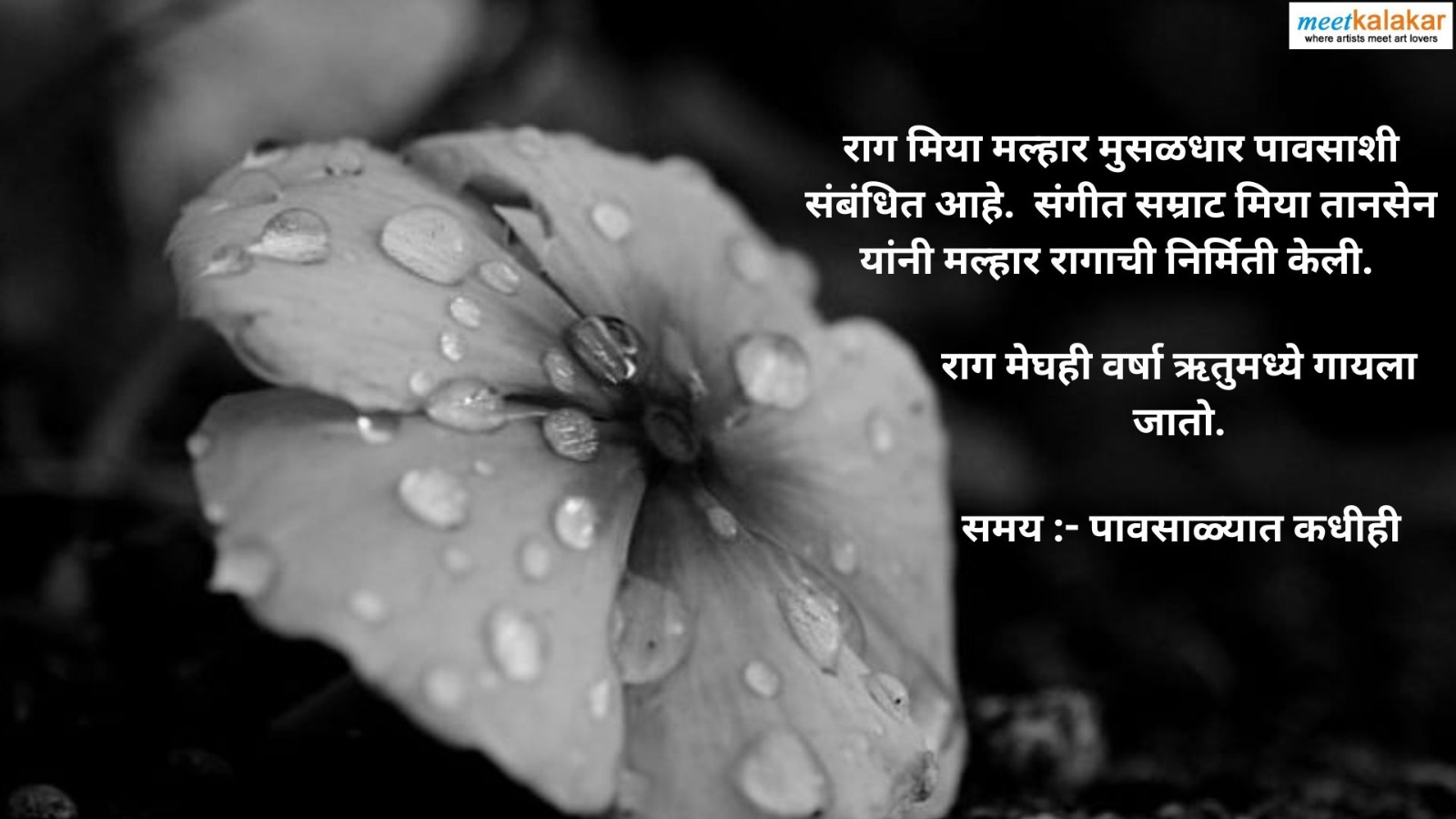
मल्हार घराण्यातील सर्वात लोकप्रिय रागांपैकी एक, राग मल्हार किंवा राग मियाँ मल्हार. मल्हार हा हिंदुस्थानी शास्त्रीय राग आहे. मल्हारचा संबंध मुसळधार पावसाशी आहे. , संगीत सम्राट मिया तानसेन यांची ही अप्रतिम निर्मिती असल्याने या रागाला 'मियाँ मल्हार' असेही संबोधले जाते. 


ढगांच्या गडगडाटात आणि आकाशातून पृथ्वीवर पडणार्‍या पावसाच्या धारांमध्ये सुरांची जुळवाजुळव खरोखरच  सुंदरतेचा अनुभव देते. मन्द्र सप्तकचा शुध्द निषाद रागाला अतिशय प्रभावी बनवतो. स्वर रचनांच्या ग्रंथांमध्ये पाऊस, गडगडाट, ढग, वीज इत्यादींचे वर्णन समाविष्ट आहे (भातखंडे). भातखंडे यांनी या रागाचे वर्णन मल्हार आणि कानडा यांचे मिश्रण असे केले आहे.


मूळ शुद्ध मल्हार व्यतिरिक्त, अनेक मल्हार-संबंधित राग आहेत -  मेघ मल्हार, रामदासी मल्हार, गौड मल्हार, सूर मल्हार, शुद्ध मल्हार, देश मल्हार, नट मल्हार, धुलिया मल्हार आणि मीरा की मल्हार. 

राग मल्हार किंवा मियाँ की मल्हार हा राग 'वृंदावनी सारंग', राग 'काफी' आणि राग 'दुर्गा' यांचे मिश्रण आहे. मियाँ की मल्हार आणि राग बहार मध्ये समान स्वर आहेत. विशेषतः मियाँ की मल्हारमधील सुरेल हालचाली गंभीर आणि संथ आहेत.

इतिहास

पौराणिक कथेनुसार, मल्हार इतका शक्तिशाली आहे की जेव्हा गायला जातो तेव्हा तो पाऊस पाडू शकतो. राग मल्हारचे अनेक लेखी वर्णने आहेत. तानसेन, बैजू बावरा, बाबा रामदास, नायक चर्जू, मियाँ बख्शू, तानता रंग, तंत्रास खान, बिलास खान (तानसेनचा मुलगा), सुरत सेन आणि मीरा बाई असे काही दिग्गज कलाकार होते आणि तेवढ्या ताकदीचे गायक होते की त्यांनी हा राग गायल्यानंतर पाऊस पडायचाच.

मुघल सम्राट अकबराने एकदा त्याच्या दरबारातील गायक-संगीतकार मियाँ तानसेनला 'राग दीपक', हा प्रकाश/अग्नीचा राग गाण्यास सांगितले, ज्यामुळे अंगणातील सर्व दिवे पेटले आणि तानसेनचे शरीर इतके गरम झाले की  स्वतःला थंड करण्यासाठी नदीमध्ये बसावे लागले. तथापि, नदी उकळू लागली आणि तानसेन लवकरच मरण पावणार हे उघड झाले. त्यामुळे स्वतःला बरे करण्यासाठी राग मल्हार गाणारा/ गाणारी कोणीतरी शोधण्यासाठी तानसेन निघाला. कालांतराने तानसेन गुजरातमधील वडनगर शहरात पोहोचला. तेथे मियाँ तानसेनला ताना आणि रिरी नावाच्या दोन बहिणी भेटल्या, मियाँ तानसेनने ताना आणि रिरी या बहिणींना मदत मागितली, बहिणींनी सहमती दिली. ज्या क्षणी ताना आणि रिरी बहिणींनी मल्हार राग गायला सुरुवात केली, त्या नंतर मुसळधार पाऊस पडला, ज्यामुळे तानसेनचे शरीर थंड झाले, अशी आख्यायिका आहे


राग मल्हारच्या अनेक रूपांचे कालक्रमानुसार वर्गीकरण करण्यात आले आहे - प्राचीन (१५व्या शतकापूर्वी), मध्यकालिना (१५वे-१८वे शतक) आणि अर्वाचिन (१९वे शतक आणि त्यापुढील). राग शुद्ध मल्हार, मेघ मल्हार आणि गौड मल्हार हे पहिल्या कालखंडातील आहेत. मल्हारच्या विविध प्रकारांमध्ये हे समाविष्ट आहे:


1) आनंद मल्हार (गान सरस्वती किशोरी आमोणकर यांनी गायलेले पहिले)

२) छाया मल्हार

3) देश मल्हार

4) गौड मल्हार

५) मीराबाई की मल्हार

6) मेघ मल्हार

7) मियाँ की मल्हार (ज्याला गायंड मल्हार म्हणूनही ओळखले जाते, निषाद शुद्ध आणि कोमल हे दोघेही (गायंड) हत्ती डोके फिरवल्याप्रमाणे धैवत भोवती फिरतात.)

8) रामदासी मल्हार

9) धुलिया मल्हार

10) चारजू की मल्हार

11) नानक मल्हार

12) शुद्ध मल्हार

13) सूरदासी मल्हार


मल्हार रागातील मराठी गाणी


1) आज कुणीतरी यावे

2) घन घन माला नभी दाटल्या

3) जन पळभर म्हणतील, हाय हाय

4) जिवलगा कधि रे येशील तू

5) माना मानव वा परमेश्वर

६) रघुपती आपल्या पदस्पर्शाने

राग मिया की मल्हार मधली हिंदी गाणी

1) बादल घुमड भर आये (चित्रपट - साज, वर्ष - 1998)

२) भय भंजना वन्दना सुन हमारी,दरस तेरे माँगे ये तेरा पुजारी (चित्रपट - बसंत बहार, वर्ष - 1956)

३) बोले रे पपीहारा, पपीहारा (चित्रपट - गुड्डी, वर्ष - १९७१)

४) करो सब निछावर(चित्रपट - लाडकी सयाद्री की, वर्ष - १९६६)

५) ना ना बरसो बादल (चित्रपट - सम्राट पृथ्वीराज चौहान, वर्ष - १९५९)

६) नाच मेरे मोर जरा नाच (चित्रपट - तेरे द्वार खडा भगवान, वर्ष - १९६४)

७) बाकड़ बम बम बम बम बाजे डमरू (चित्रपट - कठपुतली, वर्ष - १९५७


राग मेघ-मल्हार किंवा राग मेघ


मेघ हा हिंदुस्थानी शास्त्रीय राग आहे. त्यामुळे हा राग बहुतेक पावसाळ्यात गायला जातो. पावसाचे वर्णन करणारा दुसरा राग म्हणजे मल्हार. तर हे दोन राग जिथे विलीन झाले आणि एक नवीन राग विकसित झाला, तो राग म्हणजे मेघ-मल्हार. या रागाचा कर्नाटकी समतुल्य राग मध्यमावती आहे.


राग मेघ-मल्हार हा एक आनंददायी, गोड राग आहे, जो त्याच्या मूळ चौकटीत राग मधुमद-सारंग सारखा आहे. राग मेघ-मल्हारचा वादी स्वर म्हणजे षडज (सा). त्याचप्रमाणे, राग मधुमद-सारंगमध्ये नि, प हे सरळ प्रस्तुत केले आहे, तर राग मेघ-मल्हारमध्ये नि, प मल्हार अंगमध्ये (प) नि, प असे प्रस्तुत केले आहे.


हा राग गुरूमुखाकडून शिकून घेतल्यानंतरच त्यात प्रभुत्व मिळवता येते. खूप जुना राग असल्याने, मेघ-मल्हार ध्रुपद अंगाच्या प्रभावाने प्रस्तुत केला जातो, ज्यामध्ये बरेच गमक आणि मींड वापरले जातात. हा राग तिन्ही सप्तकांमध्ये मुक्तपणे मांडला जाऊ शकतो. आणि मध्यरात्रीच्या सुमारास सादरीकरणासाठी निर्धारित केलेला गंभीर आणि गहन राग मानला जातो.


संगीततज्ज्ञ व्ही.एन. भातखंडे यांनी 20 व्या शतकाच्या पहिल्या तिमाहीत (संगीत शास्त्र) लिहून असे निरीक्षण नोंदवले की मेघ-मल्हार हा केवळ काही उस्तादांनीच ओळखला आणि सादर केला असला तरी, त्यांच्या मते हा राग निपुण करणे फार कठीण नव्हते. तेव्हापासून रागाच्या लोकप्रियतेत बरीच सुधारणा झाली आहे, जरी या रागाच्या भोवतीच्या काही संदिग्धता अजूनही निराकरण न झालेल्या आहेत. सुब्बा राव (राग निधी) मेघ आणि मेघ मल्हारला एकाच रागाची दोन नावे मानतात आणि अनेक उप-आवृत्त्यांसह त्याच्या दोन आवृत्त्यांची यादी करतात. 


ऐतिहासिक माहिती


भारतीय शास्त्रीय संगीतात आढळणाऱ्या अतिशय जुन्या रागांपैकी हा एक आहे. हा राग भगवान कृष्ण काळापासून संबंधित आहे, जेव्हा गोवर्धन लीलेच्या वेळी श्रीकृष्णाने गोवर्धन पर्वताला आपल्या करंगळीवर उचलून धरून त्याखाली व्रजवासीजन व त्यांची गायीवासरे यांस आश्रय देऊन इंद्राने रागावून पाडलेल्या मुसळधार पावसापासून सात अहोरात्र त्यांचे रक्षण केले; अशी पुराणातील कथा आहे. तेव्हा भगवान शिवाने भगवान कृष्णाचे रक्षण करण्यासाठी डमरू आवाज तयार केला. डमरूने निर्माण केलेला तो राग मेघ होता.


राग दीपक (पूर्वी थाट) गायल्यानंतर तानसेनची शारीरिक लाही लाही (वेदना) , ताना आणि रिरी या दोन बहिणींनी सादर केलेला राग मेघ मल्हार ऐकून शांत झाल्याची आख्यायिका आहे.

 मेघमल्हार रागातील हिंदी चित्रपटातील गाणी

1) लपक झपक तू आ रे बदरवा (बूट पॉलिश - 1954)

२) आज मधुवतास डोले (स्त्री -१९६१)

3) अंग लग जा बालमा - ऊर्फ कारे कारे बदरा, सुनी सुनी रतिया (मेरा नाम जोकर -1970)

४) बरसो रे बरसो रे (तानसेन (१९४३)

५) दुख भरे दिन बिते रे भैया (मदर इंडिया -१९५७)

6) तन रंग लो जी (कोहिनूर -1960)

७) तुम अगर साथ देने का वादा करो (हमराज - १९६७)


For English article please click on link below -

https://meetkalakar.com/Artipedia/Megh-Malhar

https://meetkalakar.com/Artipedia/Miyaan-ki-Malhar

Monday, April 29, 2024

Classical Dances of India

India boasts a rich tapestry of classical dance forms, each originating from different regions, with unique styles, techniques, and cultural significance. Here are some of the prominent classical dance forms of India. Indian classical dance is a vibrant and captivating art form that has been passed down through generations. It preserves the rich cultural heritage of the country. These dances are a harmonious blend of graceful movements and expressive gestures. They have their roots in ancient traditions and mythology. Each dance form represents the unique cultural identity of a specific region in India. These dances captivate audiences with their beauty and storytelling. 


History And Evolution of Classical Dances in India :-

According to Bharata’s Natya Shastra, Lord Brahma combined elements from the four Vedas to form the fifth Veda, known as Natya Veda, after being asked by the Gods to create a pastime.

With words from the Rig Veda, gestures from the Yajur Veda, music from the Sam Veda and emotions from the Atharva Veda, the Natya Veda is a combination of dance, drama, and music. This demonstrates the spiritual significance dance holds in Indian cultural tradition.  Indian mythology is rife with examples of dance styles and expressions, from Shiva’s tandava dance, which symbolizes the cycle of creation, preservation, and destruction, to Parvati’s feminine response. The importance of dance as a form of social entertainment is also highlighted by the engravings of community dancing at Bhimbetka and the sculpture of a Harappan dancing girl made of bronze. In Bharata’s renowned work Natyashastra, which is a very thorough and vivid treatise on the various facets of Indian classical dance, dance was first mentioned in writing. The work, which was probably put together between 200 BC and 200 AD, goes into great detail about the ornaments, stage, costumes, techniques, postures, feelings, and even the audience.  Dance, according to Bharata Muni, is the “Complete art,” and it encompasses all other art forms, including music, sculpture, poetry, and drama.

According to Natya Shastra, Indian classical dance is composed of two fundamental elements.

Lasya: This word means grace, bhava, rasa, and abhinaya. It represents dance as an art form’s feminine characteristics.

Tandava: This dance is more focused on rhythm and movement and is symbolic of the male aspects of dance.

According to Nandikeshwara’s renowned treatise on dance, the Abhinaya Darpan (c. 5th–4th century BC), an act can be further subdivided into three fundamental components:

Nritta: This term describes the fundamental dance movements that are rhythmically performed but lack any emotion or mood. It is the movement of the limbs of the body and face.

Natya: which is a Hindi word that means dramatic representations, alludes to the dance recital’s elaborate story.

Nritya: The expression of sentiment and feelings through dance is referred to as Nritya. It incorporates mime and various forms of expression, such as dance mudras. The use of the hand and face plays an important role in conveying various emotions.

Eight classical dances recognised by the Sangeet Natak Akademi and the Ministry of Culture

1)Bharatanatyam, from Tamil Nadu (South) 

2) Kathakali from Kerala (South) 

3) Mohiniyattam from Kerala (South) 

4) Kuchipudi from Andhra Pradesh (South) 

5) Odissi from Odisha (North East)

6) Kathak from Uttar Pradesh (North) 

7) Manipuri from Manipur  (North) 

8) Sattriya from Assam  (North) 


Hasta mudras, or hand gestures, are fundamental to Indian classical dance forms, serving as a primary means of expression and communication for dancers. They add depth, nuance, and visual richness to Indian classical dance forms such as Bharatanatyam, Kathak, Odissi, Kuchipudi, Manipuri, and Mohiniyattam.

Navarasas provide dancers with a structured framework to express various emotions  including, Sringar (love ) Hasya (comic, laugh) Karun (pathetic, sad) Raudra (anger, fury) Veer  (bravery, heroic) Bhayanak  (fear) Bheebtsa (disgust) Adbhut (wondrous) Shant (Peace). By mastering the Navarasas, dancers can effectively communicate the intended emotions to the audience, creating a powerful and immersive experience.

1) Bharatanatyam :- Originating in Tamil Nadu, Bharatanatyam is one of the oldest classical dance forms of India.The origin of Bharatanatyam dates back more than 2000 years. 

Some of the important features of Bharatanatyam :- 

*Adherence to tradition: Bharatanatyam follows traditional repertoire, compositions, and techniques that have been passed down through generations. Dancers undergo rigorous training to master the classical elements of the dance form while also infusing their performances with creativity and innovation.

*With a focus on mudras, the Tandava and Lasya components of dance are equally significant in this dance style.

*Ornaments :- Temple Jewelry: Bharatanatyam dancers adorn themselves with elaborate temple jewelry crafted in gold or gold-plated metal. Temple jewelry typically includes a variety of ornaments such as the headpiece (mukut), earrings (jhumkas), necklaces (haar), bangles (kadas), armlets (vanki), and waist belts (oddiyanam).

*Dancers mainly wear costumes which are made of silk sarees with gold zari embroidery designs. The sari is usually made of silk or silk-cotton blend fabric, featuring bold colors and rich textures. Dhoti (Mundu)-  Male Bharatanatyam dancers may wear a dhoti, a traditional garment consisting of a pleated cloth wrapped around the waist and legs, paired with a fitted shirt or vest.

*Instruments used in Bharatanatyam :- Mridangam, Nadaswaram, Nattuvangam, cymbals, Flute, Veena, Violin, Manjira, Kanjira, Surpeti

*Famous dancers of Bharatnatyam  :– Rukmini Devi Arundale, Mrinalini Sarabhai, Yamini Krishnamurthy,  Padma Subrahmanyam,  Alarmél Valli, Sudha Chandran, Leela Samson etc. 

2) Kathakali :- Kathakali, a classical dance-drama form from Kerala, India, is known for its distinctive features that make it a visually stunning and emotionally captivating art form. Two types of dance dramas, Ramanattam and Krishnattam, which depict scenes from the Ramayana and Mahabharata, emerged in Kerala temples under the patronage of feudal lords, which is believed to have been the precursor to Kathakali. 

Here are some key features of Kathakali:-

*Elaborate Makeup (Paccham): One of the most striking features of Kathakali is its elaborate makeup, known as paccham. The makeup involves the use of natural colors and intricate designs to portray different characters, with green representing noble and virtuous characters, red symbolizing evil and villainous characters, black for forest dwellers or demons, and yellow for female characters.

*Colorful Costumes: Kathakali costumes are vibrant and colorful, featuring elaborate skirts, headdresses, and accessories adorned with intricate embroidery and detailing. The costumes help distinguish between various characters and add to the visual spectacle of the performance.

*Facial Expressions (Navarasas): Kathakali actors use facial expressions, known as navarasas, to convey a wide range of emotions such as love, anger, fear, and compassion. The actors undergo rigorous training to master the subtle nuances of facial expressions, which are essential for portraying characters effectively.

*Eye Movements (Netrabhinaya): Eye movements play a crucial role in Kathakali, with performers using their eyes to communicate emotions, intentions, and reactions. The expressive use of eyes, known as netrabhinaya, enhances the dramatic impact of the performance and adds depth to character portrayal.

*The dance form is mainly performed by male dancers. 

*Instruments used in Kathakali dance  :- Chenda, Maddalam and Edakka.

*Famous dancers of Kathakali :-  Kalamandalam Gopi, Kalamandalam Krishna Prasad, Kottakal Sivaraman, Kalamandalam Ramankutty Nair, Kalamandalam Vasu Pisharody, Kavungal Chathunni Panicker.


3) Mohiniyattam :- Mohiniyattam originated from the word ‘Mohini,’ which means beautiful woman, and ‘attam’ means dance. It is also known as the Dance of an Enchantress. Mohiniyattam is a solo dance performance by women that was further developed by Vadivelu in the 19th century and rose to prominence under the rulers of Travancore in the present state of Kerala.

Some of the features of Mohiniyattam are as follows:

*Lasya dominance: Mohiniyattam is known for its emphasis on lasya, the feminine and graceful aspect of dance, characterized by gentle, fluid movements, subtle expressions, and delicate footwork. This lends the dance form a soft and enchanting quality, often described as "the dance of the enchantress."

*Kauthuvam and Padams: Mohiniyattam repertoire includes solo and group compositions, such as kauthuvams (invocatory pieces) and padams (lyrical compositions), which are set to poetic verses in Malayalam or Sanskrit. These compositions explore themes of love, devotion, mythology, and nature, providing a rich tapestry for artistic expression and storytelling. Atavakul, or Atavus, is a collection of 40 fundamental dance movements.

*Costumes and Attire: Mohiniyattam costumes are elegant and traditional, typically consisting of a white or off-white saree with golden borders (kasavu), worn in the traditional Kerala style. 

*Instruments associated with Mohiniyattam:-  Mridangam or Madhalam (barrel drum), Idakka (hourglass drum), flute, Veena and Kuzhitalam (cymbals).

*Famous dancers of Mohiniyattam  :- Sunanda Nair, Kalamandalam Kalyanikutty Amma, Kalamandalam Kshemavathy, Dr. Vyjayanthimala Bali, Dr. Padma Subrahmanyam, Jayaprabha Menon, Pallavi Krishnan, Gopika Varma.Vijayalakshmi, Radha Dutta, Rema Shrikant


4) Kuchipudi :- The dance form is known to have been named after the Andhra Pradesh village of Kuchelapuram. The South-East Indian state of Andhra Pradesh is home to the classical dance style known as Kuchipudi. 

Some of the features of Kuchipudi are as follows:

*Blend of Dance and Drama: Kuchipudi is unique in its integration of dance and drama, combining expressive dance movements with narrative storytelling, making it a complete theatrical experience.

*Sutradhara Tradition: Kuchipudi performances often feature a Sutradhara, a narrator or conductor, who guides the audience through the storyline and facilitates seamless transitions between dance sequences and dramatic elements.

*For Women Kanchipuram Silk Sari: Kuchipudi dancers often wear traditional Kanchipuram silk saris, which are known for their rich colors, intricate designs, and lustrous texture. The saris are draped in the Nivi style, with  fan-shaped pleats arranged neatly and pallu elegantly draped over the shoulder. The name for the costumes used by males is known as Bagalbandi. 

*Instruments used in the Kuchipudi  : - Mridangam, Cymbals, Veena, Flute, Tambura

*Famous dancers of Kuchipudi  :– Guru Smt. Vijaya Prasad, Vempati Chinna Satyam, A Lakshmana Swamy, Sharmila Biswas, Sanchita Bhattacharya, Radha Reddy and Raja Reddy, Yamini Krishnamurthy, Vyjayanthi Kashi etc.


5) Odissi :-The earliest reference to the Odissi dance can be found in the caves of Udayagiri-Khandagiri. The dance form gets its name from the ‘Odra nritya’ mentioned in Natya Shastra. It was primarily practiced by the meharis’ and was supported by Jain King Kharavela. 

Some of the features of odissi are given below:

*Curvilinear Movements: - Odissi is characterized by its fluid and curvilinear movements, inspired by the sculptures of ancient Odisha temples. Dancers execute graceful poses, bends, and arcs with precision, creating a visual tapestry of flowing lines and sculptural beauty.

*Tribhangi and Chauka: - Odissi incorporates the tribhangi (three bends) and chauka (square) stances, which are fundamental to the dance technique. The tribhangi posture involves deftly bending the body at the neck, torso, and hips, creating elegant S-shaped curves. The chauka stance, with its firm and grounded posture, symbolizes stability, balance, and symmetry.

*Female dancers wear brightly colored saris made of local silk and embellished with traditional and local designs, such as the Bomkai Saree and the Sambalpuri Saree. The front of the sari is worn with pleats or a separate pleated cloth stitched in front to allow the dancer to move freely while displaying excellent footwork.

*Jewellery :- Necklaces, earrings, bangles, and anklets- all adorned with silver jewellery. 

*Instruments used for odissi dance : - Veena, Tabla, Pakhawaj, Harmonium, Cymbals, Violin, Flute, Sitar

*Famous dancers of Odissi dance :- Guru Pankaj Charan Das, Guru Kelu Charan Mohapatra, Deba Prasad Das, Sujata Mohapatra, Sonal Mansingh 

For more details click on Link :- https://meetkalakar.com/Artipedia/Odissi-Dance

6) Kathak :- Kathak literally means ‘storytelling’. Kathak traces its origins to northern India, particularly in the states of Uttar Pradesh. This led to the evolution of Kathak dance as early as 400 BCE. The kathakaras are a caste of storytellers who moved from place to place to disperse their art of storytelling. The modern form of kathak dance gained popularity due to the efforts of Wajid Ali Shah.  

Here are some special and important features of Kathak:

*Narrative Tradition: Kathak has a strong narrative tradition, where dancers tell stories, legends, and mythological tales through expressive movements, gestures, and facial expressions.

*Gharana System: Kathak is known for its gharana system, where different lineages or schools (gharanas) have distinct styles, techniques, and repertoire, such as Lucknow, Jaipur, and Benaras gharanas.

*Taal and Layakari: Kathak emphasizes intricate rhythm patterns (taal) and rhythmic improvisation (layakari), showcasing the dancer's skill in maintaining complex rhythms and executing rhythmic variations.

*Expressive Abhinaya: Kathak places a strong emphasis on abhinaya, or expressive storytelling, where dancers convey emotions, characters, and moods through facial expressions, hand gestures (mudras), and body language.

*Footwork and Spins: Kathak is renowned for its intricate footwork (tatkar) and graceful spins (chakkars), which require precision, control, and agility from the dancer, often accompanied by the rhythmic sounds of ankle bells (ghungroo).

*Improvisation and Creativity: Kathak allows for improvisation and creativity within the framework of traditional compositions, giving dancers the freedom to interpret and embellish movements while staying true to the essence of the dance form.

*Interaction with Musicians: Kathak dancers often have a close interaction with musicians during performances, engaging in rhythmic dialogues (tabla-bols) and musical exchanges (bol-bant), creating a dynamic and collaborative atmosphere.

*The accompaniments used in kathak dance are: - Harmonium, Tabla, Flute, Sitar and Padhant 

*Costumes worn by kathak dancers :- Ghagara Choli Odhani/Dupatta or Anarkali suits and Ghungroo.

*Ornaments :- Earrings, necklaces, bangles  and bindi have their unique importance in kathak performances.

*Famous dancers associated with kathak dancers :- Janaki Prasad, Shambhu Maharaj, Damayanti Joshi, Sitara Devi, Uma Sharma, Gopi Krishna, Birju Maharaj, Kumudini Lakhia etc.


7) Manipuri:- The mythological origin of the Manipuri dance style can be traced to the celestial dance of Shiva and Parvati in the Manipur valleys, along with the local “Gandharvas.”

Some of the features of Manipuri dance are as follows:

*Ras Leela and Krishna Bhakti: Manipuri dance is deeply rooted in devotion and spirituality, with a significant emphasis on the Ras Leela, a form of devotional dance-drama depicting the love story of Lord Krishna and the gopis (cowherd maidens). The dance celebrates the divine love of Radha and Krishna, embodying themes of devotion, surrender, and divine union.  

*The dance form is performed mainly by Females.

*The female dancers wear “patloi” dresses. The lehenga is called “Kumin,” and it is intricately woven with mirrors and zari work into beautiful designs. It is layered with transparent silk, also known as “Pasuan.” The choli is also embroidered with zari, silk, or gota. They wear a transparent odhni on their heads, covering their faces, allowing the dancer’s expression and emotion to be seen. Gopis are usually dressed in red, whereas Radha is dressed in green. Krishna, the male dancer, is dressed in saffron.

*The male performers wear a dhoti, kurta, and turban, which is white in colour, apart from a shawl folded on the left shoulder.

*Instruments associated with Manipuri dance : -Drums, Cymbals, String instruments

*Famous dancers associated with Manipuri dance :- Darshana Jhaveri, Yumlembam Gambhini Devi, Guru Bipin Sinh, Nirmala Mehta, Guru Bipin Singh, Charu Mathur, Nayana, Ranjana & Suverna, Devyani Chalia


8) Sattariya :- Sattriya dance, in its modern form, was introduced in Assam by Vaishnava Saint Sankaradeva in the 15th century AD. The name Sattariya comes from the Vaishnava monasteries known as ‘Sattras,’ where it was primarily practiced. The dance form finds mention in the Natya Shastra of Bharata Muni. It was influenced by the Bhakti Movement.

Some of the features of the Sattriya dance are as follows:

*Liturgical Dance: Sattriya is primarily a liturgical dance form, performed as part of religious rituals, festivals, and devotional ceremonies in the Sattras. It serves as a form of worship (seva) and offering to Lord Krishna and other deities, embodying the spiritual connection between the dancer, the audience, and the divine.

*Themes and Mythology: Sattriya repertoire draws inspiration from Hindu mythology, particularly the stories of Lord Krishna, Radha, and the divine love (bhakti) between them. Dancers portray various characters and episodes from the epics like the Ramayana and Mahabharata, as well as compositions of Sankaradeva and Madhavadeva, enriching the dance with mythological narratives and cultural symbolism.

*Costumes: Sattriya costumes are traditional and elegant, reflecting the cultural heritage of Assam. Female dancers wear a set of costumes comprising a richly woven Mekhela (wrap-around skirt) and Chador (upper body wrap), adorned with traditional Assamese motifs and designs. Male dancers wear Dhoti-Kurta or Cheleng-Sador, complemented by traditional Assamese headgear.  Traditionally, the costumes were white or raw silk, with red, blue, and yellow accents for specific dance numbers.

*Instruments used in Sattariya dance : - Khol, Cymbals, Flute

*Famous Sattariya dancers :- Bayanacharya Ghanakanta Bora Muktiyar, Jatin Goswami, Manik Barbayan and Bhabananda Barbayan, Moniram Dutta, Sharodi Saikia, Indira PP Bora, Anita Sharma, Anwesha Mahanta and Mallika Kandali, 


The classical dance forms of India represent a treasure trove of cultural heritage, artistic expression, and spiritual depth. From the majestic movements of Bharatanatyam to the lyrical grace of Odissi, from the devotional fervor of Sattriya to the storytelling charm of Kathakali, each dance form carries with it centuries of tradition, innovation, and cultural significance.

Sankalan by Meetkalakar Team

Credits 

https://en.wikipedia.org/

https://testbook.com